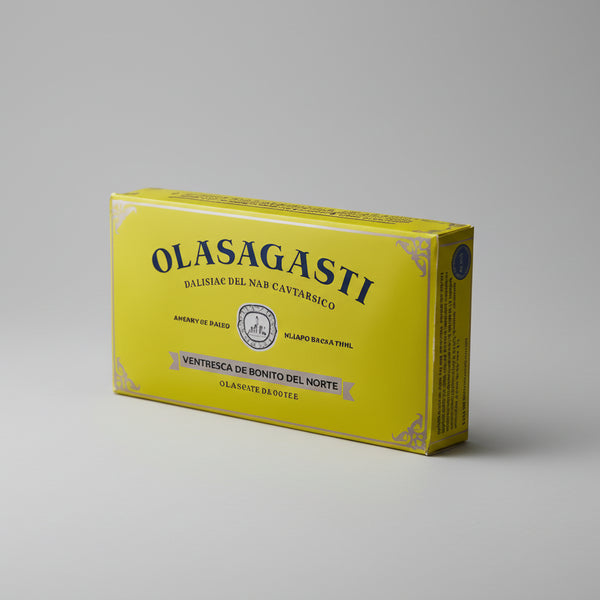


Summary: Albacore tuna (Thunnus alalunga) is not the same as yellowfin tuna (Thunnus albacares). They are distinct species, with different flavors, textures, and prices. Many consumers pay albacore tuna prices for disguised yellowfin tuna. In this guide, we teach you how to distinguish them, choose well, and get the most out of each can.
Table of Contents
- What exactly is Albacore Tuna?
- Albacore Tuna vs. Yellowfin Tuna: Real Differences
- In Olive Oil vs. in Escabeche: When to Choose Each
- Reading the Label: What Really Matters
- The Fishing Season: Why Timing Matters
- Signs of Quality in a Can of Albacore Tuna
- Albacore Tuna in the Kitchen
- Storage and Serving Temperature
- Frequently Asked Questions
What exactly is Albacore Tuna?
Albacore tuna is the commercial name in Spain for white tuna (Thunnus alalunga), a medium-sized tuna that lives in temperate waters of the North Atlantic and the Cantabrian Sea. It is a distinct species from yellowfin tuna (Thunnus albacares) and bluefin tuna (Thunnus thynnus). It is not a variety, it is not a quality designation: it is literally a different fish.
Thunnus alalunga is visually distinguished by its extraordinarily long pectoral fins — hence its English name, longfin tuna — and by its white flesh, which contrasts with the pink flesh of yellowfin tuna and the dark red of bluefin tuna. This white flesh gives it its gastronomic identity: a more delicate texture, a finer and less intense flavor than yellowfin tuna, with a moderate fat content that makes it juicy without being heavy.
In Spain, albacore tuna has a century-old canning tradition concentrated in Cantabria and the Basque Country, where the fishing season attracts thousands of specimens every summer. It is, along with Cantabrian anchovy, the star product of Spanish artisanal canning.

Albacore Tuna vs. Yellowfin Tuna: Real Differences
This is the most profitable confusion in the Spanish canning industry. Many consumers use "bonito" (albacore) and "atún" (tuna) interchangeably, which allows some manufacturers to take advantage of the ambiguity to overcharge for inferior products.
Species
Albacore tuna is Thunnus alalunga. Yellowfin tuna is Thunnus albacares or Katsuwonus pelamis (skipjack). They are biologically distinct species, with different habitats, sizes, and nutritional profiles. The law requires that the sales designation reflect the species, but many packages use small print for the species and large print for the commercial name.
Flavor and Texture
Albacore Tuna: white flesh, firm but tender texture, delicate flavor with subtle sea notes and a slightly fatty undertone that provides juiciness. It separates into clean flakes. The olive oil flavor complements the fish without overpowering it.
Yellowfin Tuna: pinkish flesh, a more compact and somewhat drier texture, a more intense and "fishy" flavor. It breaks into less defined pieces. It is an honest and versatile product, but with a less elegant flavor profile.
Price
Albacore tuna costs 2 to 4 times more than yellowfin tuna of comparable size. The difference is due to three factors: lower abundance of the species, a shorter fishing season (summer run), and higher cost of selective fishing (hook vs. purse seines).
Catch Area
Cantabrian albacore tuna is caught in FAO area 27 (Northeast Atlantic). Yellowfin tuna mostly comes from the Indian Ocean or the Pacific (FAO areas 51, 57, 71). Check the FAO area on the label: if a can says "bonito del norte" (albacore tuna) but the FAO area is not 27 or 34, something is not right.
Gourmet Canned Goods — Artisanal Selection
Anchovies, sardines, albacore tuna, belly. Selected by experts since 1990.
View Canned Goods →In Olive Oil vs. in Escabeche: When to Choose Each
Albacore Tuna in Olive Oil
This is the classic and most versatile format. Olive oil — which should be extra virgin in a quality product — provides a fatty medium that maintains the juiciness of the tuna, softens its flavor, and integrates it into a well-rounded experience. It is the ideal format for direct consumption, in salads, on bread, and in any preparation where the tuna is the star.
The covering oil of albacore tuna is, in itself, a valuable ingredient. It absorbs flavor from the fish during maturation in the can and works as an instant vinaigrette for salads or as a base for a dressing.
Albacore Tuna in Escabeche
Escabeche (oil + vinegar + spices) provides an acidity and aromatic profile that contrast with the delicate flavor of the tuna. It is a more robust, flavorful format, ideal for tapas, sandwiches, and dishes where a more defined taste is desired. Quality escabeche uses wine vinegar (not synthetic), paprika, bay leaf, and pepper.
Albacore tuna in escabeche is also the format that best holds up to mixing with other strong ingredients: piquillo peppers, caramelized onion, capers. Where tuna in oil demands the spotlight, tuna in escabeche generously shares the plate.
And in sunflower oil?
If you find albacore tuna in sunflower oil, be suspicious. Sunflower oil is a neutral and cheap medium that adds nothing to the product. Its presence in a preserve sold as premium is inconsistent: if the manufacturer saves on the oil, what else have they saved on?
Reading the Label: What Really Matters
The same principles for reading labels of any gourmet canned good apply here, with specific nuances for albacore tuna.
Sales denomination: it must say "Bonito del Norte" (Albacore Tuna) or "Atún Blanco" (White Tuna). If it says "Atún claro" (Yellowfin Tuna), "Atún" (Tuna) alone, or "Bonito" (Bonito) without "del Norte," it is not Thunnus alalunga. In Spain, "bonito" alone can refer to Sarda sarda, a different and less commercially valuable fish.
Fishing method: "Caught by rod and line" or "Hook-and-line fishing" indicates selective fishing, piece by piece. "Purse seine" indicates mass fishing with nets. Hook-and-line caught tuna arrives at the boat in better condition and allows for more rigorous selection. Purse-seine caught tuna may include specimens damaged by the net.
Drained weight: always calculate the price per gram of drained tuna, not per can. The differences between brands can be 30-50% once the real calculations are made.
"In extra virgin olive oil": the exact wording matters. "Olive oil" (without virgin or extra) is refined oil. "Vegetable oil" can be anything.
The Fishing Season: Why Timing Matters
The albacore tuna fishing season ("costera") is the fishing campaign that takes place between June and October in the Cantabrian Sea, with peak activity in July-August. During these months, schools of Thunnus alalunga migrate from the open Atlantic to the coastal waters of northern Spain to feed, and are intercepted by the artisanal fleet.
Coastal albacore tuna has superior characteristics: it has spent months feeding intensively in the Atlantic, arriving in the Cantabrian Sea at its optimal point of fat content and muscle development. Its flesh is whiter, juicier, and more flavorful than that of the same animal at other times of the year.
Manufacturers who work exclusively with coastal albacore tuna state this on the label because it is a powerful commercial argument. If the can does not specify "costera" or indicate the catch season, the tuna probably comes from out-of-season catches or other geographical areas, with an inferior quality profile.
Coastal albacore tuna canned after the summer season reaches its optimal flavor between 12 and 24 months after canning. During this time, the olive oil and the fish meat integrate, creating a more well-rounded and balanced product than a freshly made preserve.

Signs of Quality in a Can of Albacore Tuna
When opening a can of quality albacore tuna, these indicators should be present:
Color: ivory white or very light beige. Genuine albacore tuna is noticeably whiter than yellowfin tuna. If the flesh is pink, it is not albacore tuna.
Flake texture: quality tuna separates into clean, defined flakes, with a firm but tender consistency. If the contents crumble into irregular or pasty pieces, the canning process was not careful or the fish was not fresh when processed.
Oil: extra virgin olive oil has a yellow-green color and a perceptible fruity aroma. If the oil is colorless or odorless, it is probably not extra virgin.
Fish/oil ratio: a quality can has more tuna than oil. If upon opening you see more liquid than solid, the actual drained weight is low, and you are paying oil at the price of fish.
Aroma: clean, marine, with a hint of olive oil. No rancid, metallic notes, or excessive fishy smell.
At Bacalalo, we select coastal albacore tuna, in extra virgin olive oil, from Cantabrian producers with full traceability. Every can we sell meets these criteria because we don't sell what we wouldn't consume ourselves.
Albacore Tuna in the Kitchen
In Salad
Albacore tuna salad is probably the most popular use and also the most mistreated. Most "bonito" salads use shredded yellowfin tuna as a filler. The authentic albacore tuna version is something else: large flakes of white fish on top of the salad, not mixed in but placed as the star. Ripe tomato, sweet onion, green pepper, black olives, and the oil from the can itself as dressing. This is how it is eaten in the Basque Country and how it should always be eaten.
In a Sandwich
The albacore tuna sandwich with piquillo peppers is a classic of northern Spain that needs nothing more than good bread, tuna in oil, and roasted piquillo peppers. The key is not to skimp on tuna or flatten the sandwich: the flakes should remain intact. A drizzle of oil from the can over the bread completes the sandwich.
In an Empanada
The Galician albacore tuna empanada is one of the great dishes of traditional Spanish cuisine. The filling contains shredded tuna, poached onion, pepper, tomato, and hard-boiled egg. The dough should be thin so that the filling is the star. Albacore tuna makes a finer and more elegant empanada than yellowfin tuna.
In Marmitako
Marmitako is the quintessential Basque tuna stew: fresh or canned tuna, potatoes, choricero pepper, onion, and tomato. When using canned tuna, the oil from the can replaces part of the cooking oil, adding extra flavor. It is a hearty, seafaring, and perfectly balanced dish.
As a quick tapa
An open can of albacore tuna, at room temperature, with a fork and quality bread on the side is a perfect tapa. It needs nothing else. A quality product stands on its own. Add a few drops of lemon if you wish, or some Padrón peppers. But the tuna alone is enough.

Storage and Serving Temperature
Unopened: store in a cool, dry place, at room temperature (15-22°C). No refrigeration is necessary. Canned albacore tuna has a shelf life of 4-5 years and, as mentioned, improves during the first 12-24 months.
Once opened: transfer to a glass container with a lid. The tuna should be covered with oil. Consume within 2-3 days. Always refrigerate.
Serving temperature: room temperature. Take the can out 15-20 minutes before serving. Olive oil partially solidifies when cold, dulling the aromas and slightly hardening the fish's texture.
Explore our selection of albacore tuna at Bacalalo. Since 1990 in the Mercat del Ninot, selecting only what deserves to be on your table.
Gourmet Canned Goods — Artisanal Selection
Anchovies, sardines, albacore tuna, belly. Selected by experts since 1990.
View Canned Goods →🛒 Our premium alternative
⭐ 4.9/5 · Cold shipping 24-48h · Since 1990 at Mercat del Ninot
Frequently Asked Questions
Are "bonito del norte" and "atún blanco" the same?
Yes. "Bonito del norte" is the Spanish commercial name for albacore tuna (Thunnus alalunga). They are the same species. What is NOT the same is "bonito del norte" and "atún claro" (yellowfin tuna): yellowfin tuna is another species (Thunnus albacares) with different flavor, texture, and price.
How to know if a can is really "Bonito del Norte"?
The legal designation must state "Bonito del Norte" or "White Tuna". The species must be Thunnus alalunga. The flesh, when opened, should be white or very light beige, not pinkish. If the can says "Light Tuna" or simply "Bonito" without "del Norte", it is not Thunnus alalunga.
Why is Bonito del Norte more expensive than light tuna?
Three factors: less abundant species, shorter fishing season (summer coastal fishing, June-October), and a more selective fishing method (hook vs. nets). The yield per season is lower and capture costs are higher. The price difference reflects real cost differences.
What is better: Bonito del Norte in olive oil or in escabeche?
It depends on the use. Extra virgin olive oil is better for direct consumption, salads, and preparations where the bonito is the star. Escabeche adds more of its own flavor and works better in sandwiches, tapas, and dishes with strong ingredients like peppers or caramelized onions. Both are legitimate quality formats.
Does Bonito del Norte make you gain weight?
Bonito del Norte in oil has approximately 200-240 kcal per 100g drained. It is a protein food (25-28g protein/100g), with healthy fats (omega-3) and no carbohydrates. It is not a low-calorie food, but it is very nutritious and satiating. In a balanced diet, it is an excellent option.
How long does unopened canned Bonito del Norte last?
Canned Bonito del Norte has a shelf life of 4-5 years from the production date. In addition, the product improves during the first 12-24 months in the can, as the oil and meat integrate, developing more complex flavors. Store in a cool, dry place.
Can canned Bonito del Norte be frozen?
It is not recommended. Freezing alters the texture of the flakes, which lose firmness and crumble more when thawed. Since unopened cans last for years, freezing offers no practical advantage.
Related articles:
Discover our premium selection
Seafood products carefully selected since 1990 at Mercat del Ninot, Barcelona. Refrigerated shipping in 24-48h.