


![Anchoas en Carrefour: Precios, Marcas y Alternativas Gourmet [2026] - Bacalalo](http://bacalalo.com/cdn/shop/articles/anchoas-en-carrefour-precios-marcas-y-alternativas-gourmet-2026-3556808.jpg?v=1772955405&width=480)
In brief: Carrefour offers a good assortment of anchovies, from economical private-label options to renowned Cantabrian brands. Gourmet specialists work with artisan canneries and select the best batches of each season. In this guide, we compare prices, brands, and help you choose according to your use and budget.
Table of contents
- What anchovies Carrefour offers
- Carrefour's strengths in anchovies
- What a gourmet specialist offers
- Detailed comparison table
- Anchovy classification: 0, 00, Premium and more
- The great canneries of the Cantabrian Sea
- The covering oil: why it matters
- When to buy anchovies at Carrefour
- When a specialist is worthwhile
- Correct anchovy preservation
- Frequently asked questions
- Conclusion
What anchovies Carrefour offers
Carrefour has significantly expanded its anchovy section in recent years, reflecting the growing interest of Spanish consumers in this product. Its catalog includes several categories:
Carrefour private label: Anchovies in olive oil and sunflower oil. These are the most economical options, with prices starting from €1.50-3 per small can (30-50g drained). They offer decent quality for everyday use in sandwiches, salads, and pizzas.
National manufacturer brands: Carrefour distributes recognized brands such as Conservas Ortiz, El Mendi, Don Bocarte, Lorea, and others. These brands offer Cantabrian anchovies with different quality and price levels, generally between €3-8 per can (30-50g drained).
De Nuestra Tierra and selection range: Within its premium lines, Carrefour offers higher quality anchovies, sometimes with protected geographical indication or from specific canneries in the Cantabrian Sea.
Available formats:
- Small cans (30-50g): The best-selling format, perfect for an individual portion or a tapa.
- Medium cans (80-100g): For families or more generous use.
- Glass jars: Allow you to see the product before buying. Available in some premium brands.
- Salted anchovies: Less common format but available: whole anchovies in salt that require cleaning.
The general price range at Carrefour goes from approximately €25/kg (private label) to €80-120/kg (premium Cantabrian brands).
Carrefour's strengths in anchovies
Carrefour has objective advantages worth recognizing:
- Wide assortment in one place: Being able to compare 6-10 anchovy brands on the same shelf is a real advantage. It allows consumers to explore without commitment.
- Private label with good quality-price ratio: Carrefour anchovies are a decent option for daily consumption, especially considering their price.
- Promotions and packs: Offers like 2-for-1 or savings packs allow access to better quality brands at reduced prices.
- Rotation and freshness: Carrefour's high sales volume implies good product rotation, which benefits the freshness of canned goods.
- Immediate accessibility: No need to wait for deliveries or plan: you go in, buy, and have your anchovies.
What a gourmet specialist offers
Seafood specialists like Bacalalo work differently with anchovies:
Selection by harvest: Just like with wine, each anchovy season (the "costera") produces different results. Specialists select the best batches each year, discarding lots that do not meet their standards for size, fat content, and texture.
Artisan canneries: While supermarkets work with industrial or semi-industrial canneries, specialists often have access to family canneries in Santoña, Laredo, or Getaria that produce in limited quantities and prioritize quality over volume.
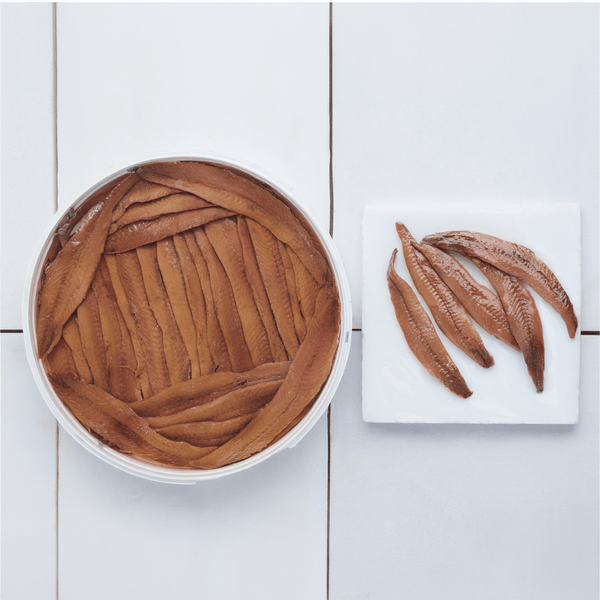
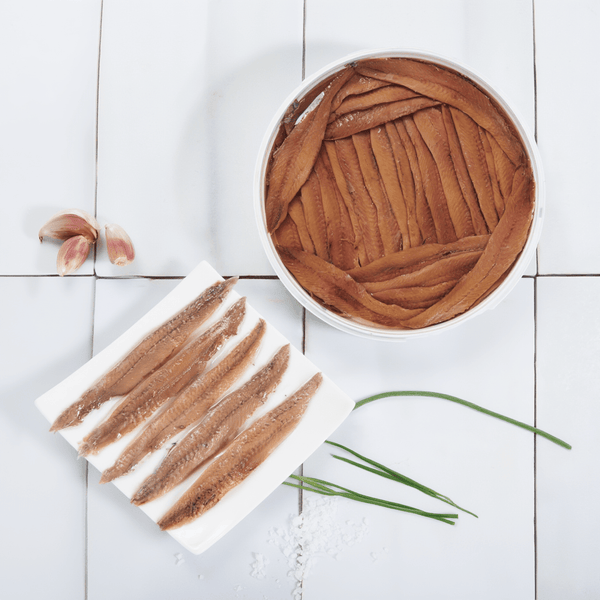
Superior caliber: Gourmet anchovies are classified by their size (caliber). Larger fillets, more difficult to obtain, are reserved for premium channels. A premium anchovy fillet can measure 8-12 cm, while an industrial one typically measures 4-6 cm.
Manual filleting: The process of hand-cleaning and filleting anchovies, known as "sobado," is an art mastered by expert canners. This manual process is slower but better respects the integrity of the fillet.
Extra virgin olive oil: Premium anchovies are covered with top-quality EVOO, not refined oils or blends. The oil is not just a covering: it adds flavor and protects the product.
Controlled maturation: The best anchovies spend between 6 and 18 months in salt before being filleted. This maturation time develops the umami flavors and melting texture that characterize a great anchovy.
Detailed comparison table
| Aspect | Carrefour (private label) | Carrefour (premium brands) | Gourmet specialist |
|---|---|---|---|
| Estimated price (€/kg) | 25-40 € | 60-120 € | 100-200 € |
| Origin | Various (can be Peru, Morocco) | Cantabrian Sea | Selected Cantabrian Sea |
| Fillet size | Small-medium (4-6 cm) | Medium (5-8 cm) | Large-XL (8-12 cm) |
| Covering oil | Sunflower or blend | Olive / EVOO | Premium EVOO |
| Process | Industrial | Semi-artisan | Artisan, hand-filleted |
| Maturation | 3-6 months | 6-12 months | 6-18 months |
| Texture | Firm, sometimes dry | Good, fleshy | Melting, dissolves |
| Ideal for | Pizza, salads, cooking | Tapas, sandwiches | Tasting, gifting, haute cuisine |
Informative comparison based on public data. Prices and availability may vary.
Anchovy classification: 0, 00, Premium and more
Cantabrian anchovies are internally classified by quality. Although there is no official regulation governing these categories, the canning industry uses a fairly standardized system:
Selection or Series 00 (Double Zero): The highest quality. Large caliber fillets, uniform pink color, melting texture, and intense yet balanced flavor. They come from the best specimens of the season, individually selected. They represent less than 10% of production.
Series 0 (Zero): Excellent quality. Good sized fillets with slight variations in caliber or color that do not affect the taste. It is the most accessible premium category and the preferred choice for many connoisseurs.
First: Good quality. Medium caliber fillets, correct flavor, ideal for everyday quality use. This is typically what recognized brands offer in supermarkets.
Second/Economy: Smaller fillets, possibly with irregular edges or color variations. Perfectly edible and tasty, ideal for cooking or topping dishes.
The difference between a 00 anchovy and a second-grade one is not just size: maturation, fish fat content, and the skill of the master canner all influence a final result that is clearly perceptible when tasted.
The great canneries of the Cantabrian Sea
Santoña (Cantabria) is the global epicenter of canned anchovies. The tradition began with Sicilian families who emigrated to the Cantabrian coast in the early 20th century and brought with them salting techniques. Today, dozens of canneries keep this tradition alive:
Among the most recognized names are Ortiz (the most internationally known), Don Bocarte (premium), Conservas Catalina, El Capricho, Lequeitio and many others. Each cannery has its nuances: the salt level, the type of oil, the maturation time, and the caliber vary, creating distinct flavor profiles.
Gourmet specialists often work with canneries that do not distribute to large supermarkets. These limited productions sell out quickly and are reserved for channels that value and communicate the quality of the product.
The covering oil: why it matters
The oil in which anchovies are preserved is not just a simple protective liquid. It fulfills essential functions:
- Preservation: The oil creates an anaerobic barrier that prevents oxidation and deterioration of the fillet.
- Flavor: A good EVOO provides fruity, bitter, or spicy notes that complement the umami of the anchovy.
- Texture: Quality oil keeps the fillet juicy and soft over time.
Lower-grade anchovies often use sunflower oil or refined olive oil (which is technically olive oil but lacks the nuances of extra virgin). Premium anchovies use EVOO, and the most exclusive ones even specify the olive variety (Arbequina, Hojiblanca, Picual).
Tip: The oil from good anchovies is not discarded: it is used to dress salads, toast, or pasta. It is liquid gold with all the flavor of the fish.
When to buy anchovies at Carrefour
Carrefour is a smart option for anchovies in these cases:
- Use in cooking: For a pizza, a focaccia, a puttanesca sauce, or a dressing, private-label anchovies perform perfectly. The heat of cooking equalizes quality differences.
- Regular consumption in sandwiches: If you eat anchovies several times a week, Carrefour's mid-range brands offer good quality at a sustainable price.
- Discovering brands: Carrefour allows you to try several brands before settling on a favorite. It's a good starting point for exploration.
- Opportunistic purchase: When you find a premium brand on sale (something frequent at Carrefour), the quality-price ratio can be excellent.
When a specialist is worthwhile
Going to a gourmet specialist makes sense when:
- You want the best possible anchovies: Limited series, 00 selection, XL sizes. These products rarely reach mass distribution.
- As a gift: A can of premium anchovies is a gastronomic gift that impresses. Specialists usually offer careful presentations.
- Pure tasting: Anchovies alone on bread with tomato, or with a little oil and vinegar. When anchovies are the whole dish, quality makes all the difference.
- Events and special dinners: A premium anchovy board as an appetizer elevates any meal.
- Consistency: A specialist guarantees the same quality with every purchase. In a supermarket, the batch can vary.
Related products from Bacalalo

Correct anchovy preservation
A common question is how to store anchovies correctly. Although they are a preserve, their handling directly affects quality:
Unopened canned anchovies: Store in a cool, dark place (pantry, cupboard). They do not need refrigeration if the ambient temperature does not exceed 25°C. However, keeping them in the refrigerator extends their shelf life and better maintains their texture. Consume preferably before the indicated date.
Opened canned anchovies: Once opened, transfer leftover anchovies to an airtight container, completely covered in oil, and store in the refrigerator. Consume within 3-5 days.
Jarred anchovies: Always refrigerate once opened. The glass allows you to see if the oil has adequately covered all the fillets. Ensure that the remaining fillets are submerged after each use.
Salted anchovies: They are preserved for months (even years) in their salt barrel. Once opened, keep the anchovies covered in salt in a closed container in the refrigerator. Clean under the tap before consuming: remove the salt, the central spine, and the skin.
A common mistake: Storing an opened can directly in the refrigerator. The metal can transfer flavor to the oil and anchovies. Always transfer to a glass or ceramic container.
Frequently asked questions
Are Carrefour brand anchovies good?
Carrefour brand anchovies offer acceptable quality for their price range. They are a valid option for cooking (pizzas, sauces, salads) and for daily use. Their origin is usually more varied than Cantabrian brands, and the size of the fillets tends to be smaller. For a pure tasting where the anchovy is the star, premium brands or specialists offer a noticeably superior product.
How much do Cantabrian anchovies cost at Carrefour?
Cantabrian anchovies at Carrefour vary considerably depending on the brand. Mid-range options (like Ortiz) are between €3-6 per 30-50g drained can, which is equivalent to €60-120/kg. Premium options can exceed €8-10 per can. Carrefour's private labels, which are not always from the Cantabrian Sea, start from €1.50-3 per can.
What is the difference between Cantabrian anchovies and others?
Cantabrian anchovies (Engraulis encrasicolus) are distinguished by the unique ecosystem of the Cantabrian Sea: cold, nutrient-rich waters that produce an anchovy with a higher fat content and more intense flavor. In addition, the canning tradition of Santoña and its surroundings provides centuries of expertise in curing and filleting. Anchovies from other origins (Peru, Argentina, Morocco) can be good but have a different flavor profile.
What does 00 or Selection anchovies mean?
The designation 00 (double zero) or Selection indicates the highest quality category within a cannery. It refers to fillets of larger size, better color, a more melt-in-your-mouth texture, and a more balanced flavor. They represent less than 10% of the total production. These are the anchovies that canneries reserve for their most exclusive range.
How should anchovies be stored once opened?
Once the can is opened, transfer any leftover anchovies to a glass or ceramic container, making sure they are completely covered in oil. Store in the refrigerator and consume within 3-5 days. Do not store the open metal can directly in the refrigerator, as the metal can impart a metallic taste to the product.
Can premium anchovies be bought online?
Yes, specialists like Bacalalo offer premium Cantabrian anchovies with shipping throughout Spain. Canned anchovies travel perfectly as they do not require a cold chain. In fact, buying online from a specialist is often the easiest way to access limited series and 00 selections that do not reach large supermarkets.
Conclusion
Anchovies are a product where the quality difference between ranges is especially clear. A Cantabrian 00 anchovy fillet, aged for more than a year and hand-filleted, offers a taste experience that is on another level compared to an industrial anchovy.
That said, Carrefour offers a generous assortment that covers all needs: from economical anchovies for cooking to renowned Cantabrian brands for tapas. Its strength lies in variety, accessibility, and frequent promotions.
Gourmet specialists provide what large distributors cannot: access to limited series, exceptional caliber selections, and artisanal canneries that do not produce for the mass market.
Our recommendation: keep supermarket anchovies in the pantry for everyday use (cooking, snacking) and reserve specialist anchovies for when you want to enjoy them as a dish in themselves. Both options have their place in a well-stocked kitchen.
Informative comparison based on public data. Prices and availability may vary.
Products you might be interested in
Discover more


![Anchoas en BonPreu: Marcas, Precios y Comparativa con Gourmet [2026] - Bacalalo](http://bacalalo.com/cdn/shop/articles/anchoas-en-bonpreu-marcas-precios-y-comparativa-con-gourmet-2026-6808253.jpg?v=1772955402&width=480)
![Anchoas en Consum: Precio, Marcas Disponibles y Alternativas Gourmet [2026] - Bacalalo](http://bacalalo.com/cdn/shop/articles/anchoas-en-consum-precio-marcas-disponibles-y-alternativas-gourmet-2026-3455663.jpg?v=1772955407&width=480)
