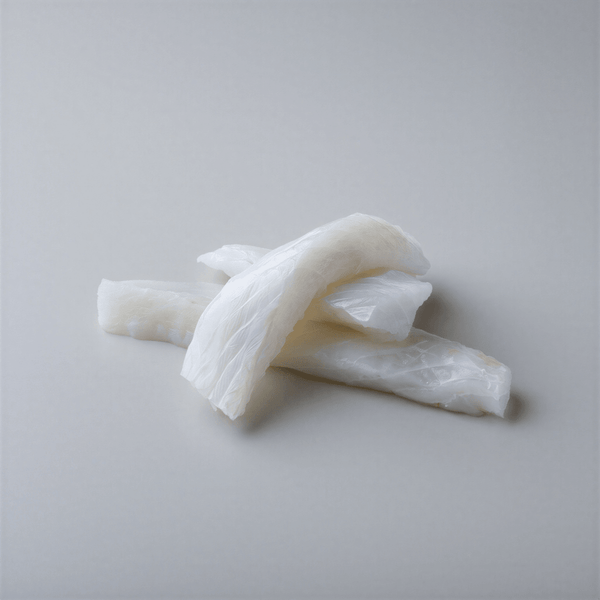
The history of cod is the history of the world: a fish that fed Vikings on their Atlantic expeditions, financed the Portuguese empire, sparked wars between nations, was a currency for centuries, and remains one of the most consumed foods on the planet today. From the drying racks of the Lofoten Islands in 800 AD to supermarkets in Barcelona, cod has traveled more than any other food in human history. This is its story, and it's more epic than you imagine.
The Vikings and Stockfish: The Origin of Everything
It all begins in Norway, around 800 AD. The Vikings needed a food that could survive weeks of sailing in open boats, without refrigeration, exposed to saltwater, wind, and cold. A food that was light to transport, rich in protein, and wouldn't spoil. They found it hanging from wooden poles in the Lofoten Islands.
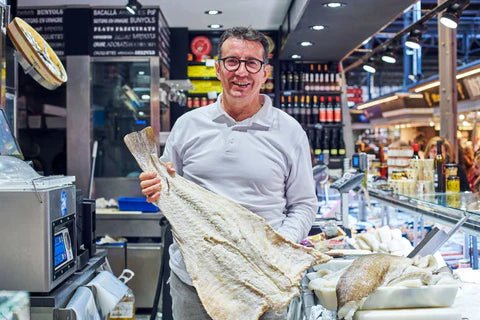
Stockfish (turrfisk in Norse, stoccafisso in Italian) is cod dried outdoors, without salt, hung on wooden racks for 3-5 months. The climatic conditions in Lofoten are perfect for this process: temperatures just above 0 °C (enough to prevent the fish from freezing, but too cold for bacteria to proliferate) and constant winds that slowly dehydrate the meat.
The result is a block of fish as hard as wood, light (it loses 80% of its weight in water), virtually rot-proof, and with extraordinary nutritional concentration: 80% protein by dry weight. One kilo of stockfish is nutritionally equivalent to 5 kg of fresh cod. It was the perfect food for Viking voyages.
With stockfish in their holds, the Vikings could sail farther than anyone. They reached Iceland (874), Greenland (985), and Newfoundland, Canada (around 1000 AD), 500 years before Columbus reached America. Without preserved cod, these voyages would have been impossible. Cod literally enabled the Viking discovery of America.
But the Vikings did more than just eat stockfish: they turned it into an export commodity. From Bergen (Norway), the main Viking port, stockfish was exported throughout Europe. Demand was enormous: the Catholic Church imposed abstinence from meat during Lent (40 days), every Friday, and on numerous vigils. This meant that for more than 150 days a year, all of Christendom needed non-meat protein. Dried cod was the perfect solution.

The Basques in Newfoundland: The Best-Kept Secret
While the Vikings dominated the stockfish trade in northern Europe, at the other end of the continent, Basque fishermen were doing something that would change the history of cod forever: salting it.
The Basque tradition of cod fishing predates written records. It is known with certainty that the Basques fished cod in the waters of the Bay of Biscay and the North Atlantic from at least the 10th century. But there is a fascinating historical mystery: the Basques began selling salted cod in huge quantities from the 12th century onwards, at a time when their known fishing grounds did not produce enough cod to justify that volume.
The theory, supported by archaeological and linguistic evidence, is that the Basques reached Newfoundland before Columbus, possibly as early as the 14th century or even earlier. They fished cod in the Newfoundland banks (the richest cod area on the planet), salted it on board with salt from the salt pans of southern France and Spain, and brought it back to Europe. But they kept their fishing grounds a secret for decades or centuries to avoid competition.
The key Basque innovation was salting. Unlike Nordic stockfish (which is dried without salt and requires a cold, dry climate that does not exist in the Basque Country), salted cod can be preserved in any climate. Salt extracts moisture from the fish and creates a hostile environment for bacteria. Well-salted cod lasts for months without refrigeration, even in warm climates.
Basque salting opened the door to something revolutionary: for the first time, cod could reach Spain, Portugal, Italy, France, and the Mediterranean in perfect condition. Southern European countries, which could not make stockfish due to their climate, now had access to preserved marine protein. The salted cod trade transformed the economy of half of Europe.
Portugal and Cod: Building an Empire
Portugal adopted cod with an intensity unparalleled in any other country. From the 15th century, when Portuguese navigators of the Age of Discovery began fishing in Newfoundland, cod became a national food.
The relationship was symbiotic: cod fueled the expeditions that built the Portuguese empire. Caravel ships sailing to India, Brazil, and Africa carried salted cod as their main provision. And the same ships that went to India for spices would stop in Newfoundland to load cod on the return journey.
Cod was the democratic food: it was eaten by nobles and peasants, sailors and monks. In a deeply Catholic society like Portugal's, where abstinence from meat was rigorously observed, cod was indispensable. And its relatively accessible price, thanks to the enormous volumes caught in Newfoundland, made it affordable for all social classes.
Portuguese cod fishing in Newfoundland continued uninterrupted for five centuries, until the 1992 moratorium. It is one of the longest commercial routes in human history.

The Hanseatic League: Cod as Currency
In northern Europe, cod was much more than food: it was money. The Hanseatic League, a confederation of northern European trading cities that dominated trade between the 13th and 17th centuries, had cod (stockfish) as one of its most valuable commodities.
Bergen (Norway) was the nerve center. Fishermen from Lofoten brought their stockfish to Bergen, where Hanseatic merchants bought it and redistributed it throughout the Baltic, the North Sea, and even to the Mediterranean. Bergen's Bryggen (the Hanseatic district, now a UNESCO World Heritage site) was literally built on the cod trade.
Stockfish served as a unit of exchange. In many areas of northern Europe, it was used to pay taxes, wages, and ecclesiastical tithes. A fisherman from Lofoten who brought his load of stockfish to Bergen did not always receive money: he often received grain, cloth, salt, beer, or tools in return. Cod was a more stable currency than many currencies of the time.
The Hanseatic League established quality standards for stockfish: weight, size, drying method, curing duration. These are the first documented food quality standards in European history, and the precursor to the systems of designation of origin we know today.
The Cod Triangle: Europe, Africa, and America
In the 17th and 18th centuries, cod was integrated into one of the most lucrative (and morally questionable) trade routes in history: the Atlantic triangular trade.
The route worked like this:
- Europe → Africa: European ships carried manufactured goods (textiles, weapons, rum) to the west coast of Africa.
- Africa → America: In Africa, these goods were exchanged for enslaved people, who were transported to plantations in the Caribbean and the Americas.
- America → Europe: Ships returned to Europe laden with sugar, tobacco, cotton, and rum.
Cod entered this circuit in a specific way: the lowest quality cod (broken pieces, overly salted, unevenly dried) was exported from Newfoundland and New England to the Caribbean, where it served as food for enslaved people on sugar plantations. It was the cheapest protein available, and its ability to be preserved in a tropical climate made it ideal.
Premium quality cod, on the other hand, was sent to European markets: Spain, Portugal, Italy, where consumers demanded quality and were willing to pay for it. This division of qualities created two completely different markets for the same product, a duality that persisted for centuries.
The New England colonies (Massachusetts, Connecticut) grew rich by exporting cod. It is no coincidence that the "Sacred Cod", a wooden carving of a cod, has presided over the Massachusetts House of Representatives since 1784. In Boston, the wealthiest families of the 18th century were those who controlled the cod trade.
The Cod Wars: Iceland vs. Great Britain
If anyone doubts the importance of cod, consider this: a fish caused three armed conflicts between two NATO allied countries.
The Cod Wars (1958-1976) pitted Iceland and the United Kingdom against each other over fishing rights in Icelandic waters. The sequence was as follows:
First Cod War (1958-1961)
Iceland extended its territorial waters from 4 to 12 nautical miles. The British Royal Navy escorted its fishing vessels to continue fishing in the disputed area. There were incidents with Icelandic coastguards cutting the trawl wires of British ships. In the end, NATO mediated and the 12-mile limit was accepted.
Second Cod War (1972-1973)
Iceland extended the zone to 50 miles. Same dynamic: British ships, naval escorts, cut cables, diplomatic tension. Iceland threatened to leave NATO (which would have left a hole in North Atlantic defense during the Cold War). The United Kingdom conceded.
Third Cod War (1975-1976)
Iceland declared a 200-nautical-mile exclusive economic zone. The Royal Navy sent frigates. Icelandic coastguards (with only 5 ships) cut trawl nets, there were deliberate collisions between military ships, and tension reached the point where Iceland broke diplomatic relations with the United Kingdom.
Iceland won. The 200-mile limit was internationally accepted and became the basis of the United Nations Convention on the Law of the Sea (UNCLOS), which today governs the exclusive economic zones of all coastal countries worldwide. A norm of international law that affects the entire planet, born from a dispute over cod.
The Collapse of Newfoundland: The Greatest Fishing Disaster
For 500 years, the Grand Banks of Newfoundland (off the coast of Canada) were the most productive cod fishing grounds in the world. 16th-century chroniclers described waters so full of cod that one could walk on their backs. In the 1960s, the annual catch exceeded 800,000 tons.
But the industrialization of fishing brought factory trawlers: enormous ships equipped with nets that swept the seabed, catching everything they found. The Soviet, Spanish, Portuguese, and Canadian fleets competed to catch more, without effective quota control.
What for centuries had seemed an inexhaustible resource proved not to be. In 1992, the Canadian government declared a total moratorium on cod fishing in Newfoundland. The population had collapsed to less than 1% of its historical level. 40,000 fishermen and processing plant workers lost their jobs overnight. It was the largest fishing disaster in history and one of the biggest ecological crises of the 20th century.
More than 30 years later, the cod population of Newfoundland has not recovered. Limited fisheries have reopened, but catches are a fraction of what they once were. Some theories suggest that the ecosystem changed permanently: species that were once prey for cod (shrimp, crabs) now dominate, leaving no room for cod to reclaim its niche.
The collapse of Newfoundland was a warning to the entire world. Thanks to it, countries like Iceland and Norway implemented the most rigorous fisheries management systems on the planet, with scientifically established quotas that maintain healthy populations.
Cod and Religion: 40 Days of Lent
One cannot understand the history of cod without understanding the role of the Catholic Church. For more than a millennium, the Church prohibited the consumption of meat during:
- Lent: 40 days before Easter
- Every Friday of the year
- Vigils of important feasts (Christmas Eve, All Saints' Day, etc.)
- Advent: the 4 weeks before Christmas (in some regions)
In total, more than 150 days a year without meat. For the European population, which depended on animal protein to survive, this created an enormous problem. Eggs and dairy were sometimes allowed, sometimes not. Fresh fish was expensive, perishable, and unavailable in inland areas.
Salted and dried cod solved the problem. It was cheap, durable, transportable to any point in Europe (even to the center of the continent, far from the sea), and rich in protein. The ecclesiastical demand for preserved fish was the economic engine that drove the entire cod industry for centuries.
In Spain, the tradition of cod during Lent is still alive: chickpea stew with cod, cod fritters, croquettes, and bacalao a la vizcaína are dishes specially prepared during Holy Week. In Mexico, cod is the Christmas Eve dish. In Italy, baccalà alla vicentina is prepared for Good Friday. The imprint of Lent on cod gastronomy is indelible.
Salted vs. Dried: Two Techniques, Two Worlds
Throughout history, cod has been preserved in two main ways, each associated with a culture and a climate:
Stockfish (dried cod, unsalted)
- Origin: Norway, Lofoten Islands
- Technique: dried outdoors for 3-5 months on wooden racks
- Climatic requirement: temperatures between -2 °C and +5 °C, constant wind, low humidity
- Result: block as hard as wood, 80% protein, lasts for years without refrigeration
- Main markets: Italy (baccalà), Nigeria, Republic of Congo, Scandinavia
- Preparation: requires rehydration for 5-7 days with multiple water changes
Salted cod (klipfisk/baccalà salato)
- Origin: Basque Country (technique), Norway and Iceland (modern production)
- Technique: salt-cured (20-25%) for weeks/months, optionally dried afterward
- Climatic requirement: none specific; salt preserves in any climate
- Result: flexible piece (wet-salted) or semi-rigid (dry-salted), concentrated flavor
- Main markets: Spain, Portugal, Brazil, Caribbean, France
- Preparation: desalting in cold water for 24-48 hours
The fundamental difference is salt. The Nordics, who had the perfect climate for drying fish but little access to salt, developed stockfish. The Basques and Portuguese, with abundant access to sea salt but a climate too warm for air-drying, developed salt-curing. Two brilliant solutions to the same problem: how to preserve perishable fish before the invention of refrigeration.